The surgical repair of an inguinal hernia is one of the most commonly performed elective procedures, worldwide. This type of hernia accounts for more than 70% of abdominal wall defects, while the lifetime risk for inguinal hernia formation is 25% in men and 3% in women.
What is an inguinal hernia?
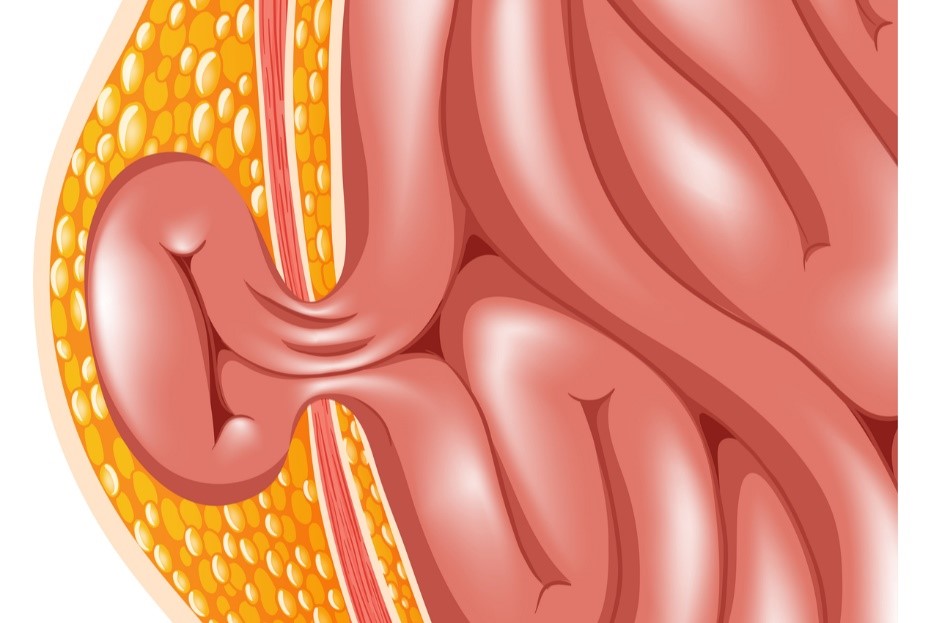
An inguinal hernia, also known as groin hernia, occurs close to the groin area, when an internal (intraabdominal) organ, usually fat or bowel, protrudes through a weakened point of the abdominal wall, close to the inguinal canal.
The muscular layers of the abdominal wall are normally strong enough to keep the abdominal organs intact. A hernia may develop when the intraabdominal pressure increases rapidly, overcoming the muscular strength of the abdominal wall. This fact results to the protrusion of abdominal contents throughout pre-existent weak points of the abdominal wall, causing the formation of a hernia.
Symptoms of inguinal hernia
The commonest and usually the only primary symptom of an inguinal hernia is the presence of a lump under the skin, close to the groin. It may appear suddenly, usually after the patient has been lifting something heavy or has been laughing or coughing intensively. Many patients notice that the lump becomes more prominent when they are straining or standing and it disappears when they are lying on the bed.
The most common symptoms of an inguinal hernia are:
- Pain or discomfort when sitting, standing, lifting weight, sneezing or coughing
- Pain during excessive activity
- Sense of weakness in the inguinal region
Causes and risk factors for the formation of an inguinal hernia
An inguinal hernia may occur due to one or more of the following factors:
- Weight lifting
- Pregnancy
- Obesity
- Chronic coughing or sneezing
- Strenuous activity
- Smoking
- Chronic constipation
- Prostate hyperplasia
- Certain connective tissue disorders
Some patients seem to be at a greater risk of developing this type of hernia. The risk factors in this population include:
- Male gender
- Aging
- Family history of inguinal hernia
- Premature birth
- Previous hernia repair on the opposite side
Inguinal hernia complications
In some cases, an inguinal hernia may result to specific complications:
- Rapid increase in the size of the hernia (inguinal / scrotal hernias):If not treated promptly by surgery, most inguinal hernias will get larger over time. In men, this means that a hernia may extend to the scrotum, resulting in swelling, discomfort and pain.
- Incarcerated hernia: Incarceration of an inguinal hernia means that its content is “stuck” in the abdominal wall of the groin and cannot be pushed back into the abdomen.
- Strangulated hernia: Incarceration of a hernia (although not a necessary pre-condition) may lead to strangulation of the hernia content. This condition alters the blood supply to the hernia content, jeopardizing the vitality of the small intestine. A strangulated hernia requires immediate surgery as it may be life threatening.
Treatment of an inguinal hernia
Inguinal hernias, like any other type of hernia, are treated surgically. Hernia repair surgery is a highly successful procedure as long as it is performed by experienced and well-trained surgeons. Dr. Charalampos Spyropoulos is one of the few surgeons in Greece, who has been certified as a Master Surgeon and Surgeon of Excellence in hernia surgery by the internationally highly acknowledged Surgical Review Corporation (SRC).
Minimally invasive surgical repair represents the golden-option in modern hernia surgery. There are many types of surgical options and the choice of the procedure depends on the type of hernia, the patient’s medical and surgical history, as well as the surgeon’s expertise.
The available surgical options for minimally invasive inguinal hernia treatment are:
- Transabdominal Pre-peritoneal repair (TAPP)
The operation is performed laparoscopically, through 3 small incisions of 5-8 mm. A laparoscopic camera (laparoscope) and the surgical instruments enter the peritoneal cavity, in proximity with the intra-abdominal viscera. After examining the area of the hernia defect, the membrane that surrounds the abdominal contents (peritoneum) is opened in the groin area, the content of the hernia is returned to its normal anatomical position and the abdominal wall is restored with a non-absorbable mesh, which is fixed with metal tackers or sutures. The peritoneum is then sutured and the procedure is completed.
- Totally Extraperitoneal preperitoneal repair (TEP)
TEP (Totally Extraperitoneal Repair) endoscopic Surgery represents the most harmonic anatomical repair among the minimally invasive surgical options for the treatment of an inguinal hernia. It is performed through three small incisions of 5-8 mm in diameter. The laparoscope is then inserted, not into the abdominal cavity but into the space behind the rectus abdominis muscle. The difference between TEP (Totally Extraperitoneal Repair) and TAPP (Transabdominal Preperitoneal Repair) technique is that the former is performed into a small space within the muscular layers of the abdominal wall, without entering the peritoneal cavity and without manipulating the intra-abdominal viscera. Therefore, the mesh is placed directly to the optimal surgical field, without the need for the use of sutures or other fixing materials, which makes the operation almost painless.
Robotic surgery is a modern, powerful therapeutic tool in the repair of abdominal wall hernias. It combines the advantages of minimally invasive surgery with the benefits provided by biotechnology and medical imaging.
The main difference between laparoscopic and robotic surgery is that during a robotic procedure, the surgeon sits in front of a robotic console with wide 3D view of the surgical field. The robotic arms of the advanced system reproduce with absolute precision all the movements performed by the surgeon, with the use of small joysticks in the robotic console, offering a unique range and freedom of movements that cannot be executed by the human hand. The robotic approach is extremely useful in cases of recurrent or multiple hernias.